# Time and Date

## Run instructions On Time

{% hint style="success" %}
These triggers is event-based and carefully crafted for optimal performance, making it more efficient and better for performance compared to frequent checks every frame.
{% endhint %}

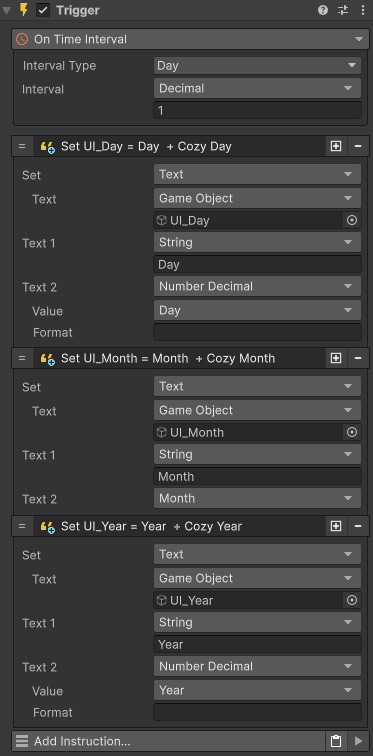
<figure><img src="/files/HnVZSpBB4t3G85ijEMwk" alt=""><figcaption><p>Using '<a href="/pages/X0i3OnMEIbzOCIgcK5tu"><mark style="color:yellow;">On Time</mark></a>', '<a href="/pages/CvcS9uUIK2B5IQeFgjdz"><mark style="color:blue;">On Day and Time</mark></a>' and '<a href="/pages/ba0Eyu5gLQXugO0PuyHr"><mark style="color:green;">On Year, Day, and Time</mark></a>' triggers to trigger based on your specific needs. Using Daily Cycle, or Yearly Cycle means that the trigger will go into 'hibernation' and not do any more checks before a new day or a new year has happened. The trigger 'On Year, Day and Time' will completely stop checking unless the Keep Checking In Past is enabled. </p></figcaption></figure>
{% hint style="info" %}
Changing the 'Use Daily Cycle', 'Use Yearly Cycle,' or 'Keep Checking In Past' settings is not recommended unless you intend to manually reset the time to a previous value (e.g., going back in time to a specific date or event).
{% endhint %}

## Display time in UI

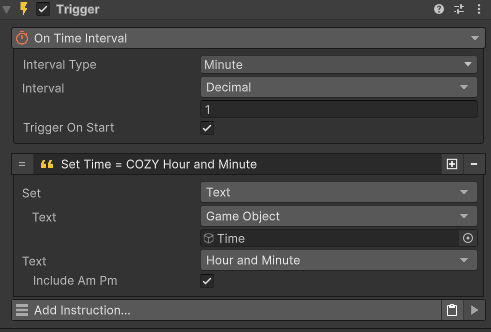
<figure><img src="/files/0vBBHxxWIrDSUC4Jm30Y" alt=""><figcaption><p>Using the '<mark style="color:yellow;">Set Text</mark>' Instruction on an '<a href="/pages/3UpSyGbnGGPL3b5ATpSM"><mark style="color:red;">On Time Interval</mark></a>' Trigger. Make sure Trigger On Start is enabled so it initialize the UI on start.</p></figcaption></figure>

## Display date in UI

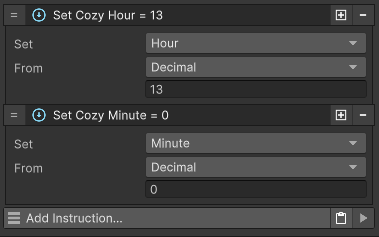
<figure><img src="/files/oKKglfi8635r50cs7W6v" alt=""><figcaption><p>Using the '<mark style="color:yellow;">Join Text</mark>' Instruction on an '<a href="/pages/3UpSyGbnGGPL3b5ATpSM"><mark style="color:red;">On Time Interval</mark></a>' Trigger. Make sure Trigger On Start is enabled so it initialize the UI on start.</p></figcaption></figure>

## Setting the time or date

{% hint style="warning" %}
Setting the time or date directly bypasses any event-based triggers that would normally be fired between the current time and the time being set.
{% endhint %}

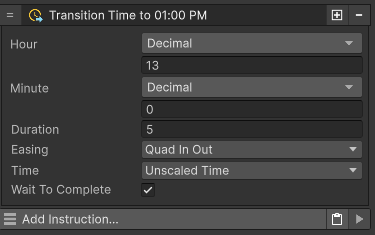
<figure><img src="/files/4EtNIQs55CLC776SuOSy" alt=""><figcaption><p>Using the <mark style="color:blue;">Set Number</mark> Instruction. In this case, the time will instantly be set to 13:00 (1 PM). Remember to use only the range 0–23 for hours and 0–59 for minutes. This logic can also be applied to setting the day or year.</p></figcaption></figure>

## Transition time

{% hint style="info" %}
If the Time Curve isn't already set to Linear, it's recommended to switch it to Linear before the transition to make it smoother.&#x20;

*This can be done using the* [*Set Time Curve*](/info/game-creator-2-assets/cozy-stylized-weather-integration/instructions/set-time-curve.md) *instruction.*
{% endhint %}

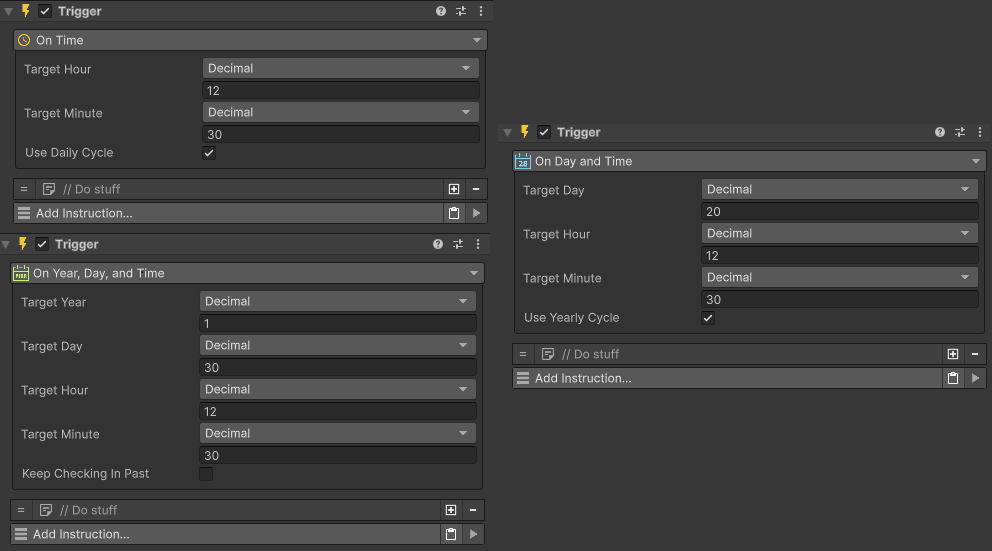
<figure><img src="/files/VywPvqFPyW9KGzBqp2iU" alt=""><figcaption><p>Using the '<mark style="color:yellow;">Transition Time</mark>' Instruction. In this case, the time will transition to 13:00 (1 PM) over 5 seconds. Remember to use only the range 0–23 for hours and 0–59 for minutes.</p></figcaption></figure>


---

# Agent Instructions: Querying This Documentation

If you need additional information that is not directly available in this page, you can query the documentation dynamically by asking a question.

Perform an HTTP GET request on the current page URL with the `ask` query parameter:

```
GET https://docs.fullscreen.no/info/game-creator-2-assets/cozy-stylized-weather-integration/guides-and-demo-scene/time-and-date.md?ask=<question>
```

The question should be specific, self-contained, and written in natural language.
The response will contain a direct answer to the question and relevant excerpts and sources from the documentation.

Use this mechanism when the answer is not explicitly present in the current page, you need clarification or additional context, or you want to retrieve related documentation sections.